

Rollforward & Balances
Rollforward & Balances
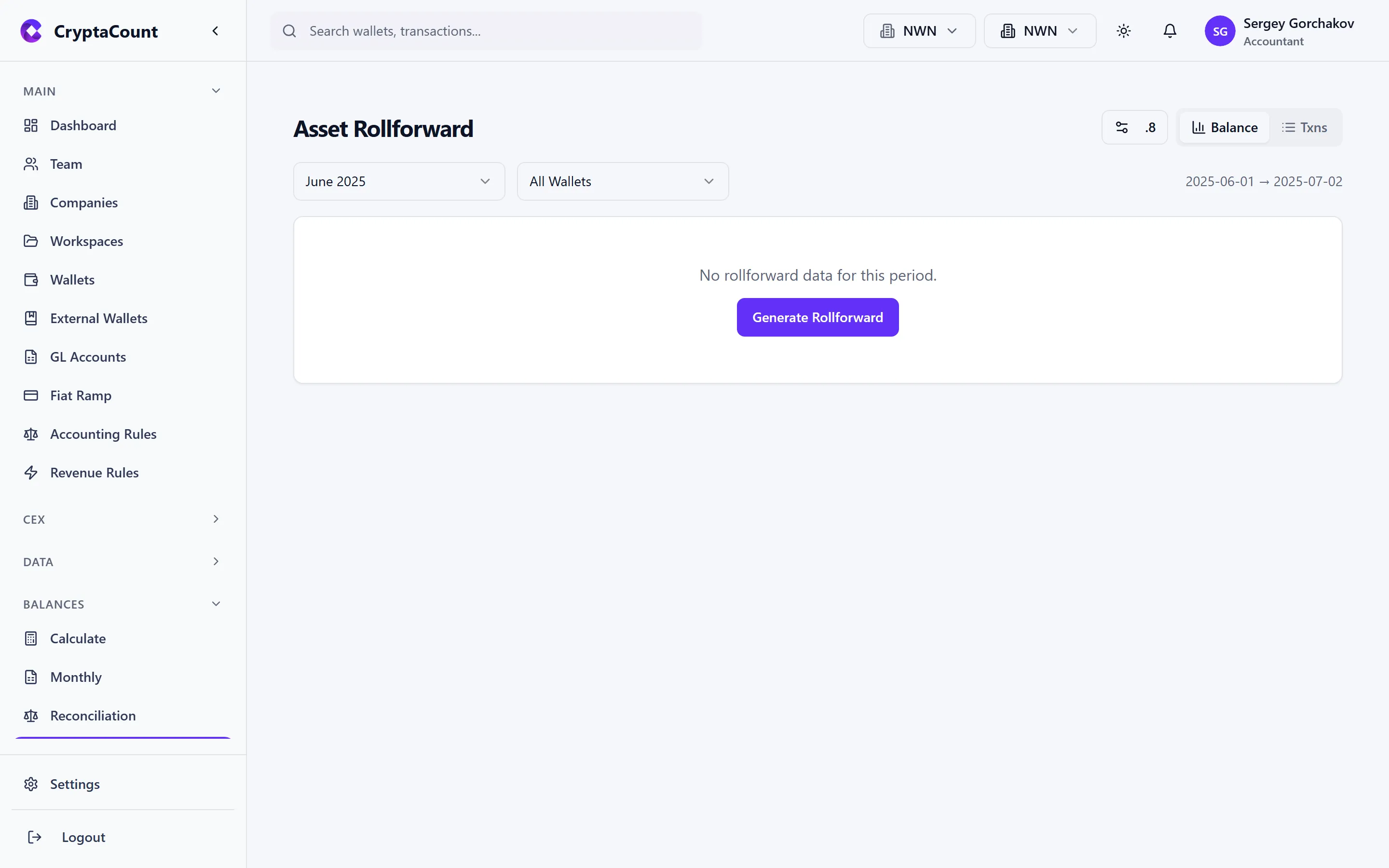
Section titled “Rollforward & Balances”The rollforward is the central reconciliation artifact in CryptaCount. Together with balance calculation, monthly snapshots, and lot-level detail, the Balances section provides complete position tracking.
What Is a Rollforward?
Section titled “What Is a Rollforward?”A rollforward (also called a “roll-forward schedule” or “movement schedule”) answers the question: How did we get from the opening balance to the closing balance?
For each asset, it shows:
Opening Balance+ Additions (purchases, transfers in, rewards, airdrops)− Disposals (sales, transfers out, fees)± Revaluations (FMV changes, FX translation)= Closing BalanceThis is the standard format expected by auditors for verifying digital asset positions.
Five-Column Structure
Section titled “Five-Column Structure”CryptaCount’s rollforward tracks five dimensions simultaneously:
| Column | What It Measures | How It’s Calculated |
|---|---|---|
| Quantity | Number of units held | Sum of in/out transactions |
| Cost (USD) | Historical acquisition cost in USD | Purchase price × quantity at each acquisition |
| FMV (USD) | Current fair market value in USD | Market price × quantity at period end |
| Cost (EUR) | Historical cost translated to EUR | Cost USD × FX rate at each acquisition date |
| FMV (EUR) | Fair market value in EUR | FMV USD × closing FX rate at period end |
All five columns must reconcile independently: opening + additions − disposals ± adjustments = closing.
Balance Calculation
Section titled “Balance Calculation”Trigger balance calculations under Balances → Calculate:
- Synchronous calculation — For smaller workspaces, computes immediately
- Asynchronous calculation — For larger workspaces, runs in the background with progress tracking
- In-progress tracking — Monitor currently running calculations
- Retry — Re-run failed calculations
- Diagnostics — Investigate stuck or failed balance computations
- Validation — Verify calculated balances against on-chain data
Monthly Balances
Section titled “Monthly Balances”Monthly snapshots under Balances → Monthly provide:
- Balance state at each month-end
- Month-over-month comparison
- Trend analysis across periods
- Export for external reporting
Lot Viewer
Section titled “Lot Viewer”The lot viewer under Balances → Lots provides granular visibility into individual lots:
- View each acquisition lot with date, quantity, and cost basis
- See which lots have been partially or fully disposed
- Select specific lots for Specific Identification disposals
- Track lot-level holding periods for tax classification
FX Translation Components
Section titled “FX Translation Components”For workspaces reporting in EUR (or any non-USD currency), three components reconcile the FMV column:
FMV Revaluation
Section titled “FMV Revaluation”The change in fair market value, translated using the monthly average exchange rate (per IAS 21). This isolates the asset’s price movement from FX fluctuations.
FX Translation
Section titled “FX Translation”The impact of exchange rate changes on the balance, calculated using the closing rate (the rate on the last day of the period). This captures the pure FX effect.
FX on Revaluation
Section titled “FX on Revaluation”The balancing difference — the amount needed to make the columns reconcile after FMV Revaluation and FX Translation. This arises from the interaction between asset price changes and FX rate changes.
Audit Use Cases
Section titled “Audit Use Cases”The rollforward is the primary document auditors use to verify digital asset positions:
- Completeness: All transactions are accounted for (opening + movements = closing)
- Accuracy: Cost basis and FMV calculations are correct
- Classification: Each movement is properly categorized
- FX treatment: Translation methodology is consistent and IAS 21-compliant
- Reconciliation: Closing quantity matches on-chain balance; FMV matches market data