
DeFi Transactions
Decentralized finance (DeFi) interactions are among the most complex events to account for. CryptaCount provides a dedicated DeFi module with pipeline processing, position tracking, bridge reconciliation, gas fee analysis, and derivatives support.
Availability
Section titled “Availability”The DeFi module is available on qualifying plans. When enabled, the following sections become available in the sidebar:
| Sidebar Label | Feature |
|---|---|
| DeFi → Pipeline | Accounting pipeline — process and review DeFi events |
| DeFi → Positions | DeFi positions — LP, lending, staking positions |
| DeFi → Bridges | Bridge tracking — cross-chain transfers |
| DeFi → Gas Fees | Gas fee analysis and reporting |
DeFi Accounting Pipeline
Section titled “DeFi Accounting Pipeline”The pipeline under DeFi → Pipeline processes DeFi events through a status workflow:
PENDING → CLASSIFIED → POSTED (or FAILED / MANUAL_REVIEW / SKIPPED)Events enter as PENDING, are classified by the engine, and then posted as journal entries. Events that can’t be auto-classified go to MANUAL_REVIEW for human intervention.
The pipeline view shows:
- Pending events awaiting classification
- Events in review status needing manual attention
- Status counts per stage
- Multi-leg transaction groups (DeFi operations that span multiple legs)
DeFi Positions
Section titled “DeFi Positions”Track active DeFi positions under DeFi → Positions:
- All positions — Complete list of DeFi positions across protocols
- Active positions — Currently open positions
- LP positions — Liquidity pool positions with impermanent loss tracking
- Lending positions — Deposits and borrows in lending protocols
Position data includes:
- Protocol and pool/vault identifier
- Deposited assets and quantities
- Current value vs. deposited value
- Accumulated rewards
- Rebase token tracking for rebasing assets
DeFi Transaction Types
Section titled “DeFi Transaction Types”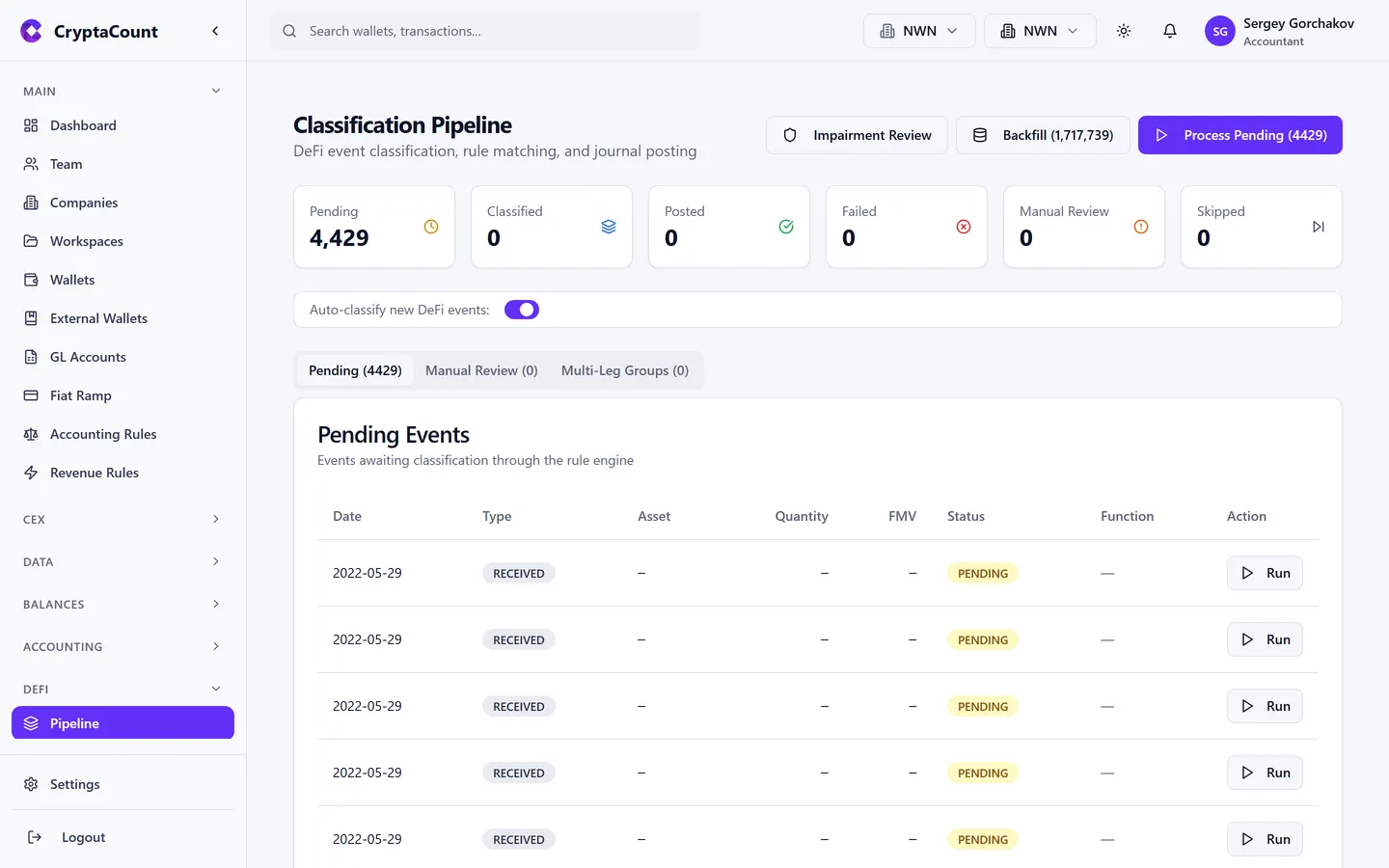
Swaps (DEX Trading)
Section titled “Swaps (DEX Trading)”Type: SWAP
Trading one token for another on DEXes (Uniswap, SushiSwap, Curve, etc.). The disposal triggers a realized gain/loss on the source token. The destination token is acquired at FMV.
Liquidity Provision
Section titled “Liquidity Provision”Types: LP_ADD, LP_REMOVE
- Add: Deposited assets are transferred to the pool. LP tokens acquired at the combined FMV.
- Remove: LP tokens are disposed. Received assets are acquired at current FMV. Difference represents gain/loss (may include impermanent loss).
Staking
Section titled “Staking”Types: STAKE, UNSTAKE, CLAIM_REWARD
- Stake: Assets are locked but typically not disposed (still owned). No taxable event in most jurisdictions.
- Unstake: Assets unlocked and returned.
- Claim Reward: Reward tokens recognized as income at FMV at time of claim.
Lending and Borrowing
Section titled “Lending and Borrowing”Types: BORROW, REPAY, LENDING_DEPOSIT, LENDING_WITHDRAW, LIQUIDATION
- Lending deposits: Assets deposited, receipt tokens received
- Interest earned: Recognized as income at FMV when claimed
- Borrowing: Not income — creates a liability. Repayment reduces the liability.
- Liquidation: Forced position closure — recorded with appropriate gain/loss
Wrapping and Unwrapping
Section titled “Wrapping and Unwrapping”Types: WRAP, UNWRAP
Converting between a native asset and its wrapped version (ETH ↔ WETH, BNB ↔ WBNB, FTM ↔ WFTM).
Default treatment: a disposal of the original asset and an acquisition of the new one. Gain or loss is realised, and neither cost basis nor holding period carries across the wrap.
The reason is that a wrapper is a different token with its own contract: ETH is deposited into the WETH contract and a new ERC-20 is minted. What you hold afterwards is a claim on a contract, not the asset you started with.
This is jurisdiction-dependent. Some jurisdictions treat wrapping as a taxable disposal; others treat it as a continuation of the same holding. Where a jurisdiction rules that a wrap is not a disposal, that ruling governs. No jurisdiction-specific ruling is configured today, so the default applies everywhere.
Wrapping is not the same as a contract rename — see Token Migrations, where basis does carry.
This treatment applies to 1:1 wrapping only. Yield-bearing wrappers such as stETH, and rebasing tokens, are tracked separately through the DeFi Positions rebasing feature.
Yield Claims
Section titled “Yield Claims”Type: YIELD_CLAIM
Claiming accumulated yield from DeFi protocols. Recognized as income at FMV at time of claim.
Bridge Transactions
Section titled “Bridge Transactions”Types: BRIDGE_OUT, BRIDGE_IN
Bridge tracking under DeFi → Bridges manages cross-chain asset movements:
- Stale bridge detection — Identifies BRIDGE_OUT transactions without matching BRIDGE_IN
- Resolution — Manually resolve stale bridges by linking the corresponding transaction on the destination chain
- Bridge fees are recorded as expenses
Default treatment: a bridge is a disposal on the source chain and an acquisition on the destination chain. Gain or loss is realised, and neither cost basis nor holding period carries across.
ETH on Ethereum and ETH on Arbitrum are legally distinct assets, and the distinction is sharper for some bridges than others:
| Bridge type | What you actually hold afterwards |
|---|---|
| Custodial (WBTC) | A claim against a custodian who holds the BTC. Counterparty risk the underlying never had. |
| Bridged deployment (USDC.e, LINK.e) | A separate token with its own contract and its own migration history. USDC.e is not native USDC. |
This is jurisdiction-dependent. Where a jurisdiction rules that bridging is not a disposal, that ruling governs. None is configured today, so the default applies.
Matching a BRIDGE_OUT to its BRIDGE_IN establishes that the two events are one movement — it does not by itself make the movement non-taxable.
Gas Fee Analysis
Section titled “Gas Fee Analysis”Gas fee reporting under DeFi → Gas Fees provides:
- Per-wallet gas fee totals
- Gas fees by chain
- Gas fee trends over time
- Gas fees as a percentage of transaction value
This data feeds into the expense categories in financial reports.
Derivatives
Section titled “Derivatives”CryptaCount supports derivatives accounting with dedicated sections:
| Sidebar Label | Feature |
|---|---|
| Derivatives | Derivatives dashboard — overview of all derivative positions |
| Derivatives → Margin | Margin positions — open/close, collateral tracking, interest, liquidations |
| Derivatives → Futures & Options | Futures and options — positions, funding rates, mark-to-market, premium tracking |
Margin Trading
Section titled “Margin Trading”Track margin positions with collateral movements, interest accrual, and liquidation events.
Futures & Options
Section titled “Futures & Options”Track futures positions with funding rate payments, mark-to-market valuations, and settlement. Options tracking includes premium, exercise, and expiry events.
Derivatives Reports
Section titled “Derivatives Reports”- P&L Report — Profit and loss across all derivative positions
- Funding Report — Futures funding rate payments and receipts
- Open Positions — Current derivative exposure summary
Still need help?
Can't find what you're looking for? Our support team is here for you.
Evaluating CryptaCount for your firm? See pricing · Book a demo