

Reporting & Exports
Reporting & Exports
Section titled “Reporting & Exports”CryptaCount’s reporting engine produces structured financial outputs from your accounting data. All reports are generated on demand from live data — there are no stale cached reports.
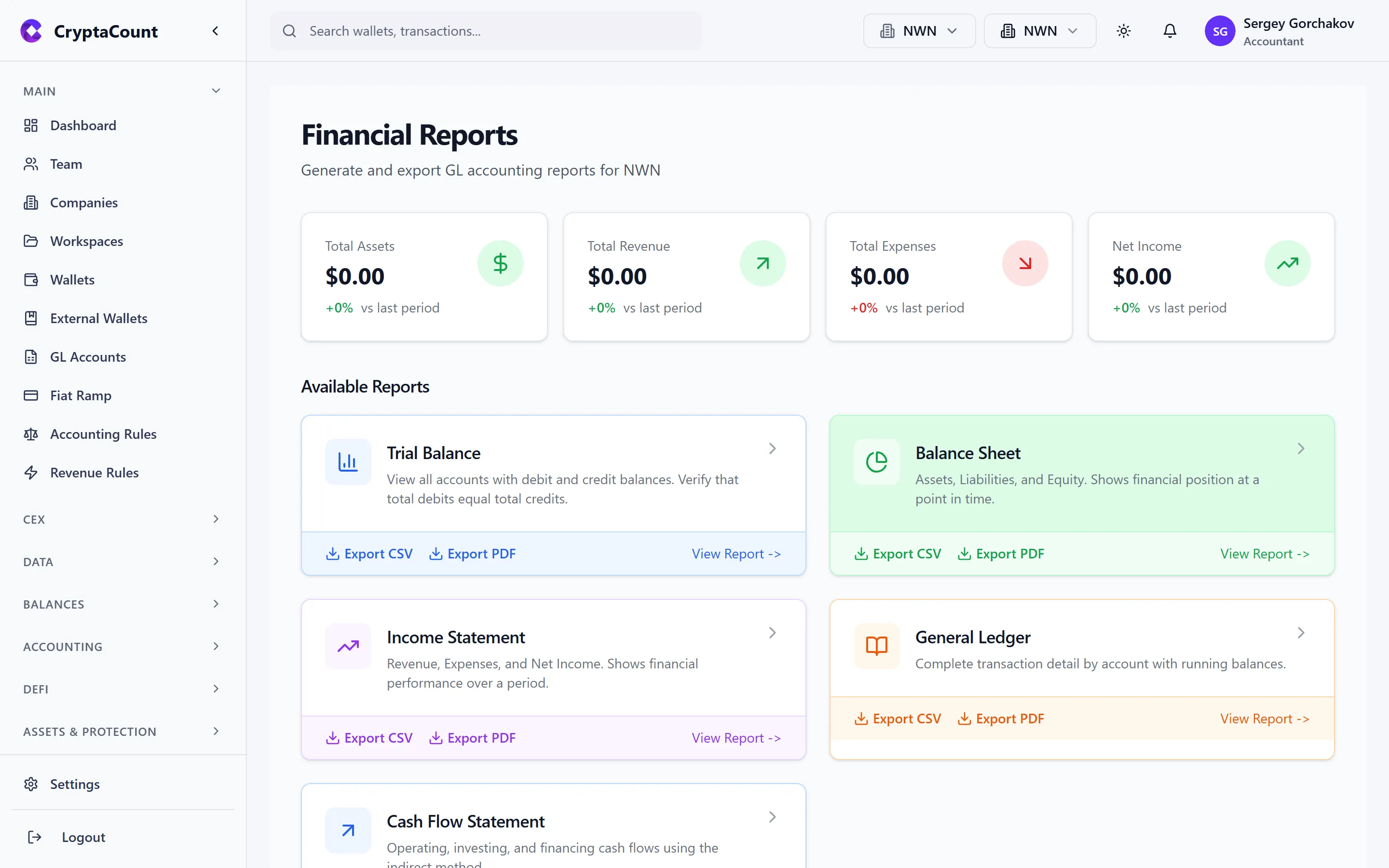
Financial Reports
Section titled “Financial Reports”Five financial reports are available from the Reports section in the sidebar:
| Report | Purpose |
|---|---|
| General Ledger | Complete journal entry record with hash chain verification |
| Trial Balance | Debit/credit balances for all GL accounts at a point in time |
| Balance Sheet | Assets, liabilities, and equity at a specific date |
| Income Statement | Revenue, expenses, gains/losses, and net income for a period |
| Cash Flow | Cash and crypto flow categorized by operating, investing, and financing activities |
General Ledger
Section titled “General Ledger”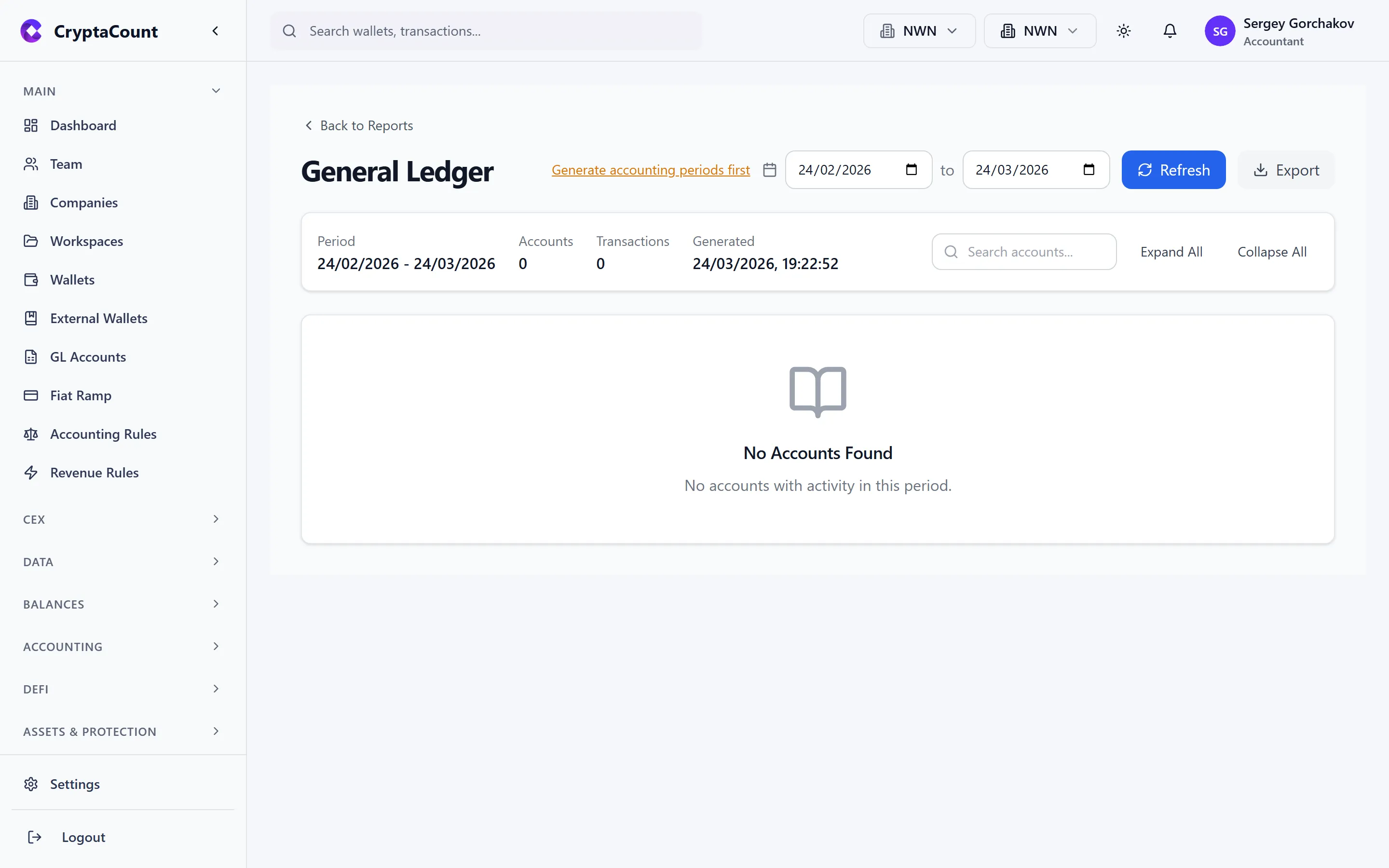
Balance Sheet
Section titled “Balance Sheet”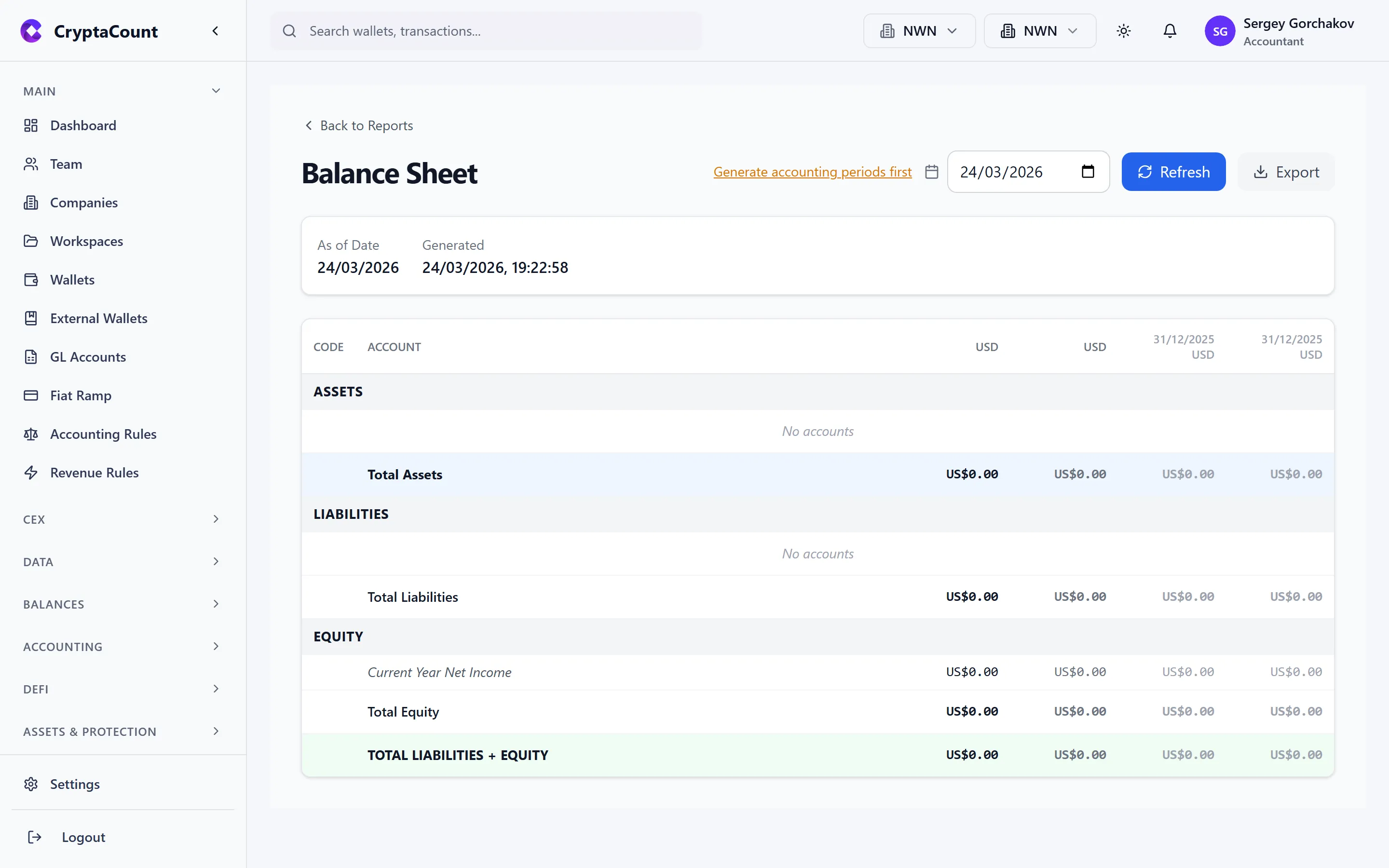
Cash Flow
Section titled “Cash Flow”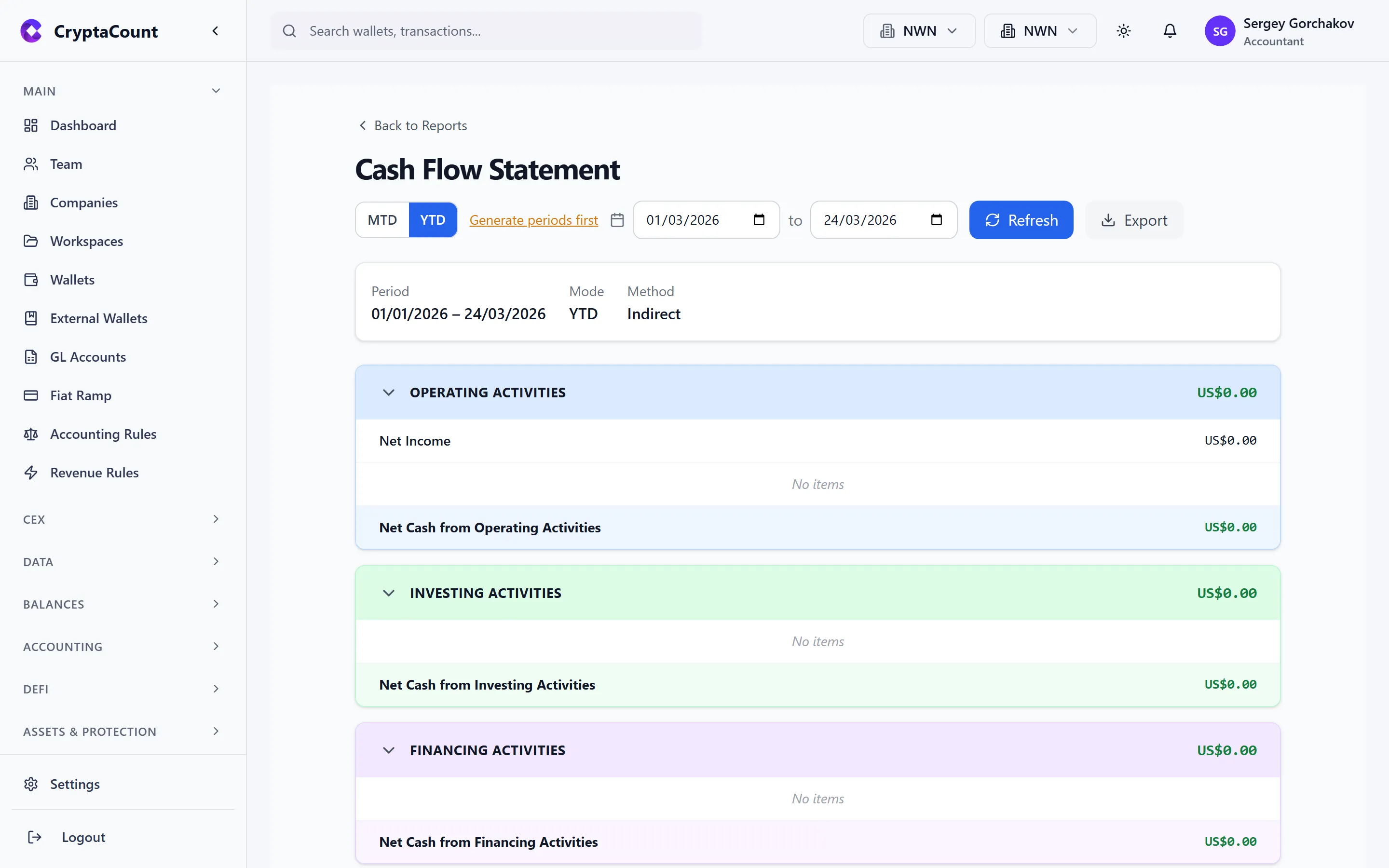
Report Configuration
Section titled “Report Configuration”All reports share common configuration options:
- Date range — Predefined period (this month, this quarter, YTD, last year) or custom dates
- Wallets — All wallets or a selected subset
- Assets — All assets or filtered to specific ones
- Cost basis method — Defaults to workspace setting; override for comparison
- Currency — Reports display in your base currency with USD also shown
Additional Report Capabilities
Section titled “Additional Report Capabilities”- Inventory Valuation — Asset inventory with cost and FMV comparison
- Gas Fee Report — Per-workspace gas fee analysis
- Annual Report — Excel export combining all financial statements
Reconciliation
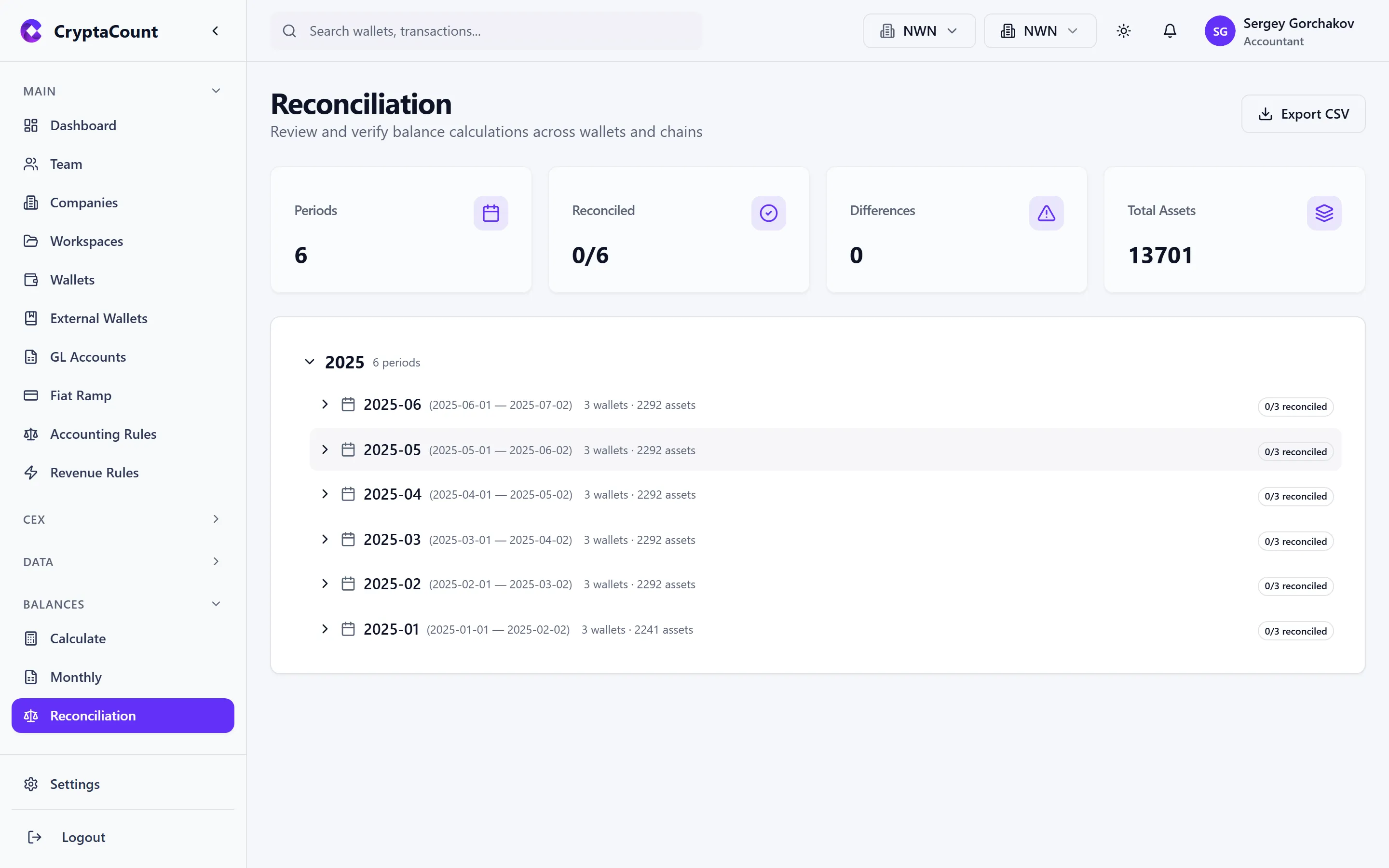
Section titled “Reconciliation”The reconciliation module under Reconciliation in the sidebar provides comprehensive data verification:
| Sidebar Label | Purpose |
|---|---|
| Reconciliation | Dashboard — overview of all checks |
| Reconciliation → Reports | Reconciliation report list and detailed findings |
Reconciliation checks include:
- Balance vs. blockchain — Compare computed balances against on-chain data
- Hierarchy reconciliation — Verify rollup consistency across the account hierarchy
- Unmapped addresses — Find transaction addresses without GL mappings
- Transaction counts — Verify expected vs. actual transaction volumes
- Opening/closing balance — Validate period transitions
- Internal transfers — Match internal transfer pairs
- Fee verification — Verify fee calculations
- Price availability — Check for missing price data
- CEX matching — Verify CEX transaction matching
- Double-entry validation — Ensure all journals balance
- Ledger replay — Replay transactions to verify journal integrity
- Data integrity — Hash chain and data consistency checks
Full reconciliation runs produce exportable reports with difference details.
Exports
Section titled “Exports”The Exports section in the sidebar provides:
- Generate exports — Create CSV, Excel, or PDF exports of any report
- Export history — View previously generated exports
- Download — Download generated export files
Zoho Export
Section titled “Zoho Export”For Zoho Books users, dedicated Zoho export functionality under Exports → Zoho provides:
- CSV exports formatted for Zoho Books import
- Account mapping between CryptaCount and Zoho chart of accounts
Export Formats
Section titled “Export Formats”| Format | Best For |
|---|---|
| CSV | Importing into other tools, data analysis, ERP integration |
| Excel (.xlsx) | Client delivery, formatted workbooks with summary rows |
| Formal deliverables, audit documentation, filing |