

Impairment Testing
Impairment Testing
Section titled “Impairment Testing”Impairment testing evaluates whether the carrying value of digital assets exceeds their recoverable amount. CryptaCount supports multiple impairment models aligned with different accounting standards and cost basis methods.
Why Impairment Matters
Section titled “Why Impairment Matters”Digital assets are volatile. Under most accounting frameworks, if the fair market value of an asset drops below its carrying cost, the entity must recognize an impairment loss. The rules for when (and whether) that loss can be reversed depend on the accounting standard and cost basis method in use.
Example: Acme Digital Holdings acquired 10 ETH at €3,200 each (carrying value €32,000). At period end, ETH trades at €2,800. The fair value is €28,000 — an unrealized loss of €4,000 that may need to be recognized as impairment.
Running an Impairment Test
Section titled “Running an Impairment Test”Navigate to Accounting → Impairment to run tests:
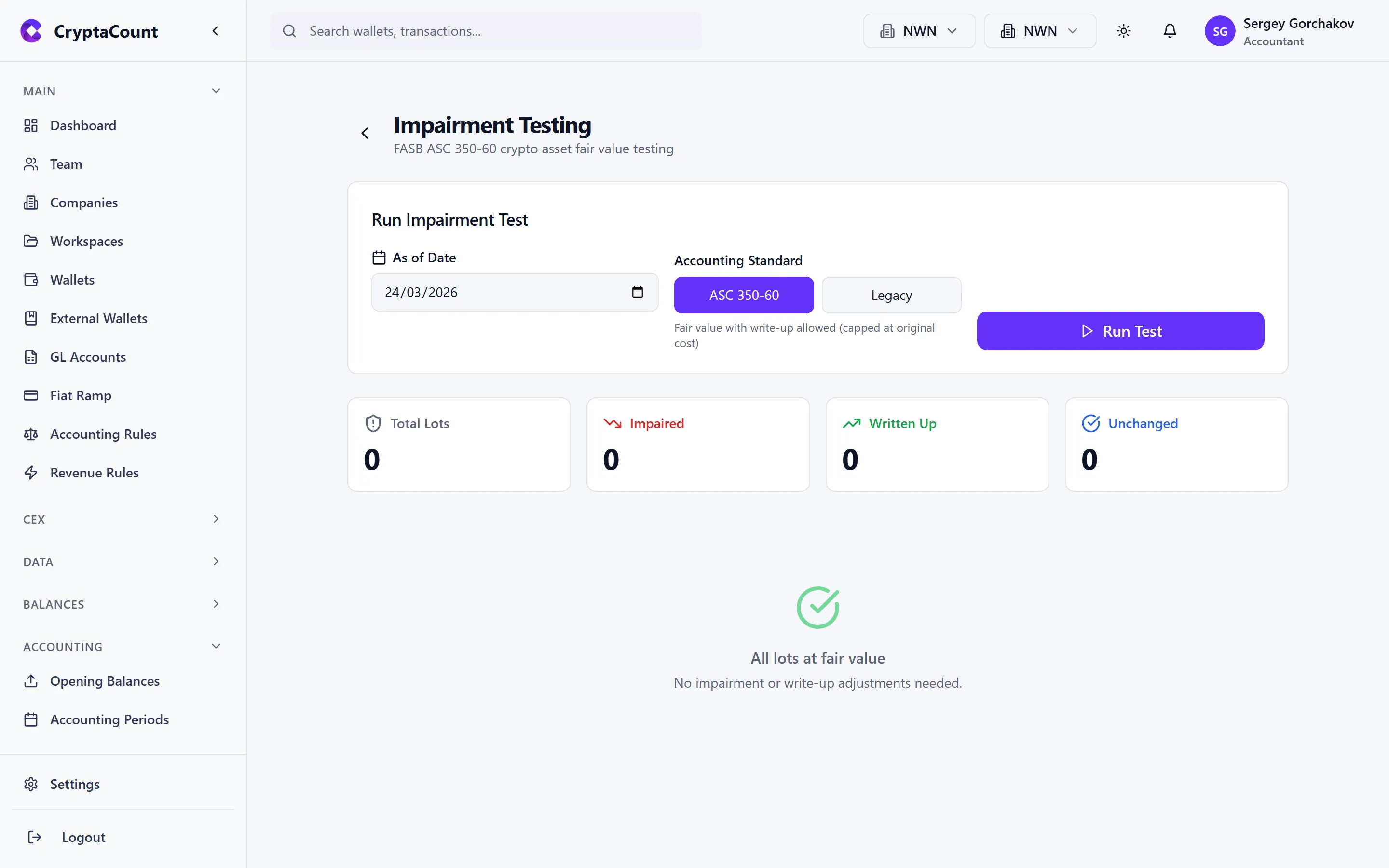
- Select the period — Choose the accounting period to test
- Run test — CryptaCount evaluates every asset position against current market prices
- Review results — Each asset shows:
- Carrying value (cost basis per the selected method)
- Fair market value at period end
- Impairment amount (if carrying value exceeds FMV)
- Prior impairment already recognized
- Net adjustment required
Results are broken down by asset, wallet, and GL account.
Impairment Models
Section titled “Impairment Models”CryptaCount applies different impairment logic based on the workspace’s cost basis method:
One-Way Impairment (Write-Down Only)
Section titled “One-Way Impairment (Write-Down Only)”Applies to: Historic FIFO, LIFO, HIFO, Specific Identification
Under one-way impairment, losses are recognized when FMV drops below carrying value, but reversals are not permitted. Once an asset is written down, the new lower value becomes the cost basis going forward.
This aligns with US GAAP treatment of indefinite-lived intangible assets and fair value guidance where impairment is permanent until disposal.
| Condition | Action |
|---|---|
| FMV < Carrying Value | Recognize impairment loss |
| FMV > Carrying Value (after prior write-down) | No reversal — carry at written-down value |
| FMV > Original Cost | No adjustment — carry at original cost |
Journal entry for impairment:
| Account | Debit | Credit |
|---|---|---|
| Impairment Loss — ETH | €4,000 | |
| Digital Assets — ETH | €4,000 |
Two-Way Impairment (Write-Down & Reversal)
Section titled “Two-Way Impairment (Write-Down & Reversal)”Applies to: NRV + FIFO, NRV + Weighted Average
Under two-way impairment (Net Realizable Value methods), losses are recognized when FMV drops below carrying value, and reversals are permitted when FMV recovers — but only up to the original cost basis, never above it.
This aligns with IFRS treatment of inventory (IAS 2) where write-downs to NRV are reversed when the circumstances that caused the write-down no longer exist.
| Condition | Action |
|---|---|
| FMV < Carrying Value | Recognize impairment loss (write down to NRV) |
| FMV > Carrying Value (after prior write-down) | Reverse impairment, up to original cost |
| FMV > Original Cost | Carry at original cost — no write-up beyond cost |
Journal entry for reversal:
| Account | Debit | Credit |
|---|---|---|
| Digital Assets — ETH | €2,000 | |
| Impairment Reversal — ETH | €2,000 |
Fair Market Value (Mark-to-Market)
Section titled “Fair Market Value (Mark-to-Market)”Applies to: FMV
Under the FMV method, assets are carried at fair value each period. Unrealized gains and losses are recognized in the income statement. There is no separate “impairment” concept — all value changes flow through the P&L as they occur.
Weighted Average (No Impairment)
Section titled “Weighted Average (No Impairment)”Applies to: Historic Weighted Average
The weighted average cost method does not apply impairment. The cost pool is continuously reweighted as new acquisitions occur.
Reviewing Results
Section titled “Reviewing Results”The impairment results view shows:
| Column | Description |
|---|---|
| Asset | Token symbol and name |
| Quantity | Total held quantity |
| Carrying Value | Current book value per the cost basis method |
| Fair Value | Market value at the test date |
| Impairment | Loss amount to recognize (or reversal for NRV methods) |
| Prior Impairment | Cumulative impairment already recognized |
| Net Adjustment | Amount to post in this period |
Assets with no impairment (FMV ≥ carrying value under one-way methods) show zero adjustment.
Posting Impairment Entries
Section titled “Posting Impairment Entries”After reviewing results:
- Confirm the impairment amounts are reasonable
- Click Post Impairment Entries
- CryptaCount generates journal entries for each asset requiring adjustment
- Entries are posted to the impairment loss (or reversal) GL accounts
Posted impairment entries appear in the journal ledger and are included in the period close checks.
Lot-Level Impairment
Section titled “Lot-Level Impairment”For lot-based methods (FIFO, LIFO, HIFO, Specific Identification), impairment is assessed at the individual lot level:
- Each lot’s carrying value is compared against the current FMV
- Lots acquired at different prices may have different impairment amounts
- The lot viewer under Balances → Lots shows per-lot impairment status
Example: Acme Digital Holdings holds two ETH lots:
| Lot | Quantity | Cost Basis | FMV | Impairment |
|---|---|---|---|---|
| Lot 1 (Jan purchase) | 5 ETH | €3,200/ETH | €2,800/ETH | €2,000 |
| Lot 2 (Mar purchase) | 5 ETH | €2,600/ETH | €2,800/ETH | €0 |
Lot 2 has no impairment because FMV exceeds its cost basis.