Compliance & Screening
Compliance & Screening
Section titled “Compliance & Screening”CryptaCount’s compliance module helps organizations meet regulatory obligations for anti-money laundering (AML), EU crypto-asset regulations (MiCA), tax information exchange (DAC8), and environmental reporting (carbon/ESG).
Availability
Section titled “Availability”All compliance features are available on qualifying plans.
Address Screening
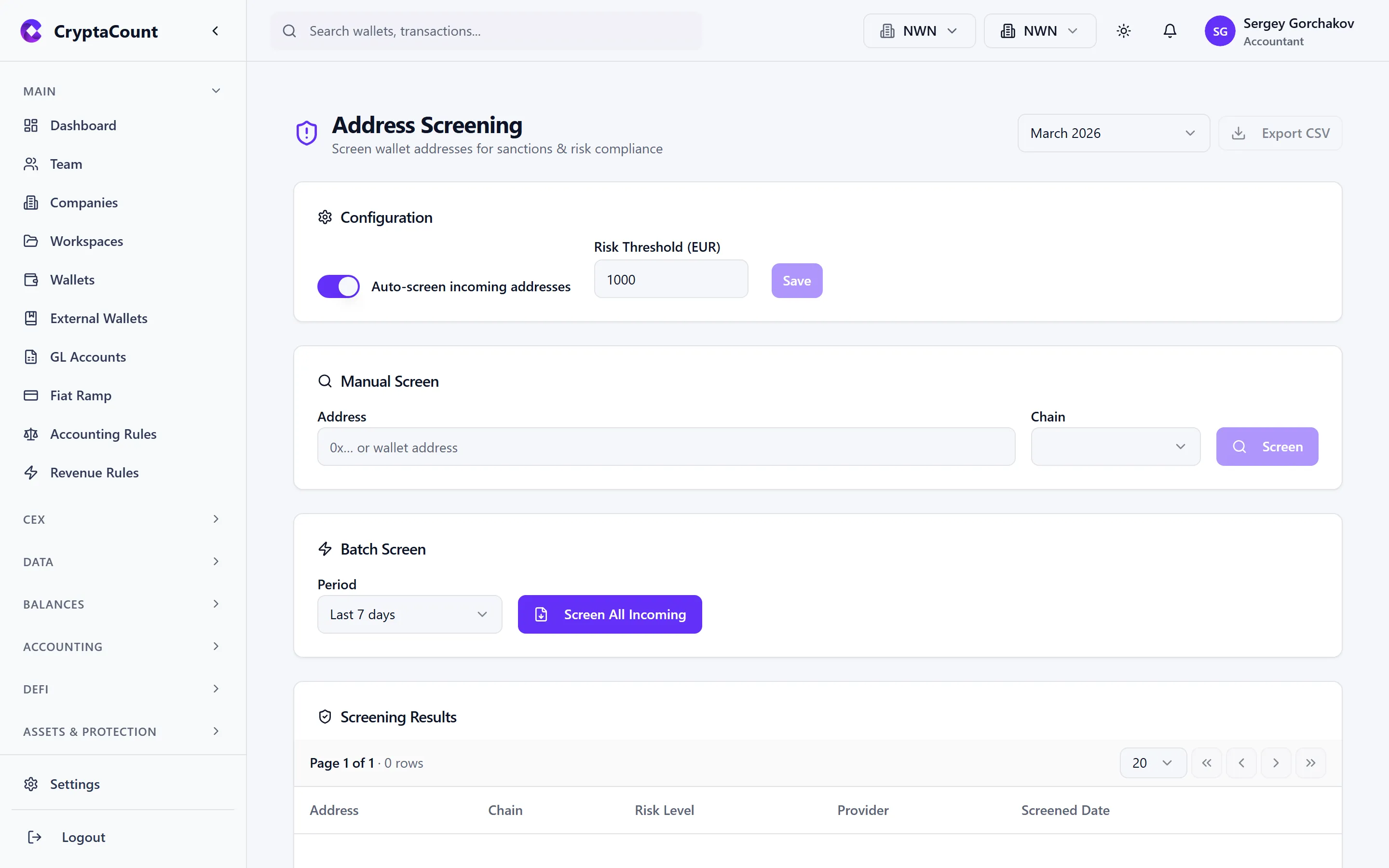
Section titled “Address Screening”Screen wallet addresses under Screening in the sidebar.
What Address Screening Does
Section titled “What Address Screening Does”Address screening checks wallet addresses against sanctions lists, known illicit actors, and risk databases. This is a core AML/CFT (anti-money laundering / counter-financing of terrorism) requirement for regulated crypto businesses.
Screening Workflow
Section titled “Screening Workflow”- Configure screening — Set up screening rules and thresholds
- Screen addresses:
- Individual — Screen a single address on demand
- Batch — Screen multiple addresses at once
- Automatic — Screen all new addresses as wallets are added or transactions are received
- Review results — Each address returns a risk assessment
- Take action — Flag, block, or document high-risk addresses
Screening Results
Section titled “Screening Results”Each screened address receives:
| Field | Description |
|---|---|
| Address | The wallet address screened |
| Risk score | Numeric risk rating (0–100) |
| Risk level | LOW, MEDIUM, HIGH, CRITICAL |
| Matches | Sanctions list matches (OFAC, EU, UN) |
| Exposure | Direct or indirect exposure to high-risk entities |
| Details | Specific list entries and match confidence |
Screening Configuration
Section titled “Screening Configuration”| Setting | Description |
|---|---|
| Lists | Which sanctions lists to screen against (OFAC SDN, EU Consolidated, UN Security Council, etc.) |
| Threshold | Minimum match confidence to flag (reduces false positives) |
| Auto-screen | Enable/disable automatic screening on new addresses |
| Alert routing | Who receives alerts for high-risk matches |
Export
Section titled “Export”Export screening results for compliance reporting:
- Full screening history with timestamps and results
- Filtered exports by risk level or date range
- Formatted for regulatory submission
Example: Acme Digital Holdings runs weekly batch screening on all counterparty addresses. The compliance officer reviews any addresses flagged MEDIUM or above and documents disposition decisions in the screening dashboard.
MiCA Compliance
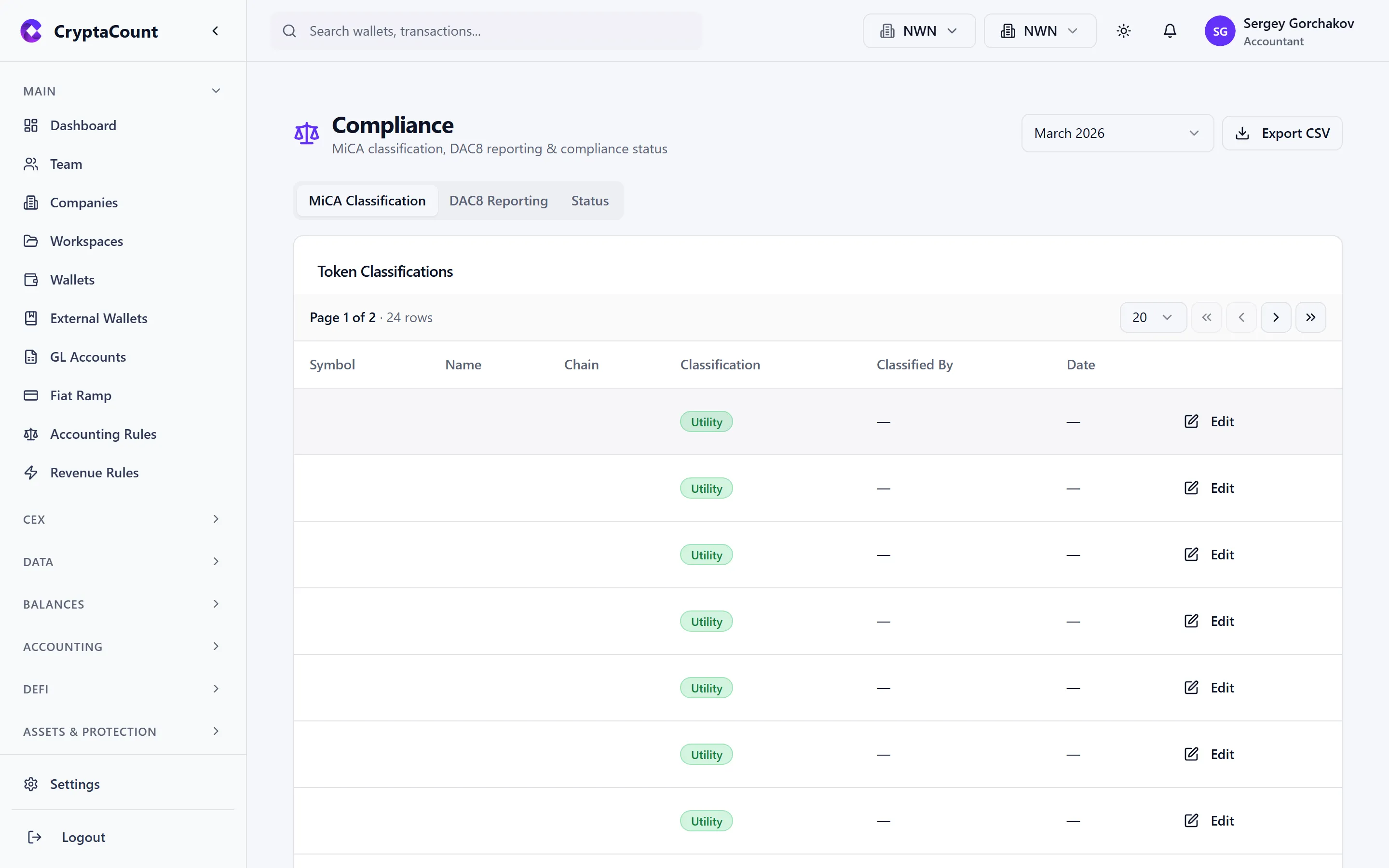
Section titled “MiCA Compliance”The Markets in Crypto-Assets Regulation (MiCA) compliance tools are accessible under Compliance in the sidebar.
MiCA Token Classification
Section titled “MiCA Token Classification”CryptaCount classifies crypto assets under MiCA categories:
| MiCA Category | Description | Examples |
|---|---|---|
| E-Money Token (EMT) | Pegged to a single fiat currency | USDC, USDT, EURC |
| Asset-Referenced Token (ART) | Pegged to a basket of assets or commodities | — |
| Utility Token | Provides access to a service or product | UNI, AAVE, LINK |
| Other Crypto-Asset | Does not fit EMT, ART, or utility definitions | BTC, ETH |
Classification Workflow
Section titled “Classification Workflow”- CryptaCount auto-classifies known tokens based on its token registry
- Review auto-classifications and override where needed
- New or unrecognized tokens are flagged for manual classification
- Classification history is maintained for audit trail
MiCA Reporting
Section titled “MiCA Reporting”Based on token classifications, CryptaCount assists with:
- Reserve requirements for EMT and ART holdings
- Disclosure obligations for significant holdings
- Transaction reporting thresholds
- Whitepaper compliance tracking for issued tokens
DAC8 Reconciliation
Section titled “DAC8 Reconciliation”The Directive on Administrative Cooperation (DAC8) extends tax information exchange to crypto-assets. CryptaCount handles DAC8 reporting from the Compliance section.
What DAC8 Requires
Section titled “What DAC8 Requires”DAC8 mandates that Crypto-Asset Service Providers (CASPs) report user transactions to tax authorities across EU member states. Key obligations:
| Requirement | Description |
|---|---|
| User identification | Verify and report user identity details |
| Transaction reporting | Report all crypto-asset transactions above thresholds |
| Cross-border exchange | Automatic exchange of information between EU tax authorities |
| Annual reporting | Submit reports by January 31 of the following year |
DAC8 Reconciliation Workflow
Section titled “DAC8 Reconciliation Workflow”- Run reconciliation — CryptaCount matches internal transaction records against DAC8 reporting requirements
- Review results — Identify gaps, discrepancies, or transactions needing additional data
- Export — Generate DAC8-compliant XML export for submission
Reconciliation Checks
Section titled “Reconciliation Checks”| Check | Description |
|---|---|
| Completeness | All reportable transactions are included |
| Identification | User identity data is present and valid |
| Thresholds | Transactions meeting reporting thresholds are flagged |
| Consistency | Internal records match external data sources |
Carbon / ESG Estimation
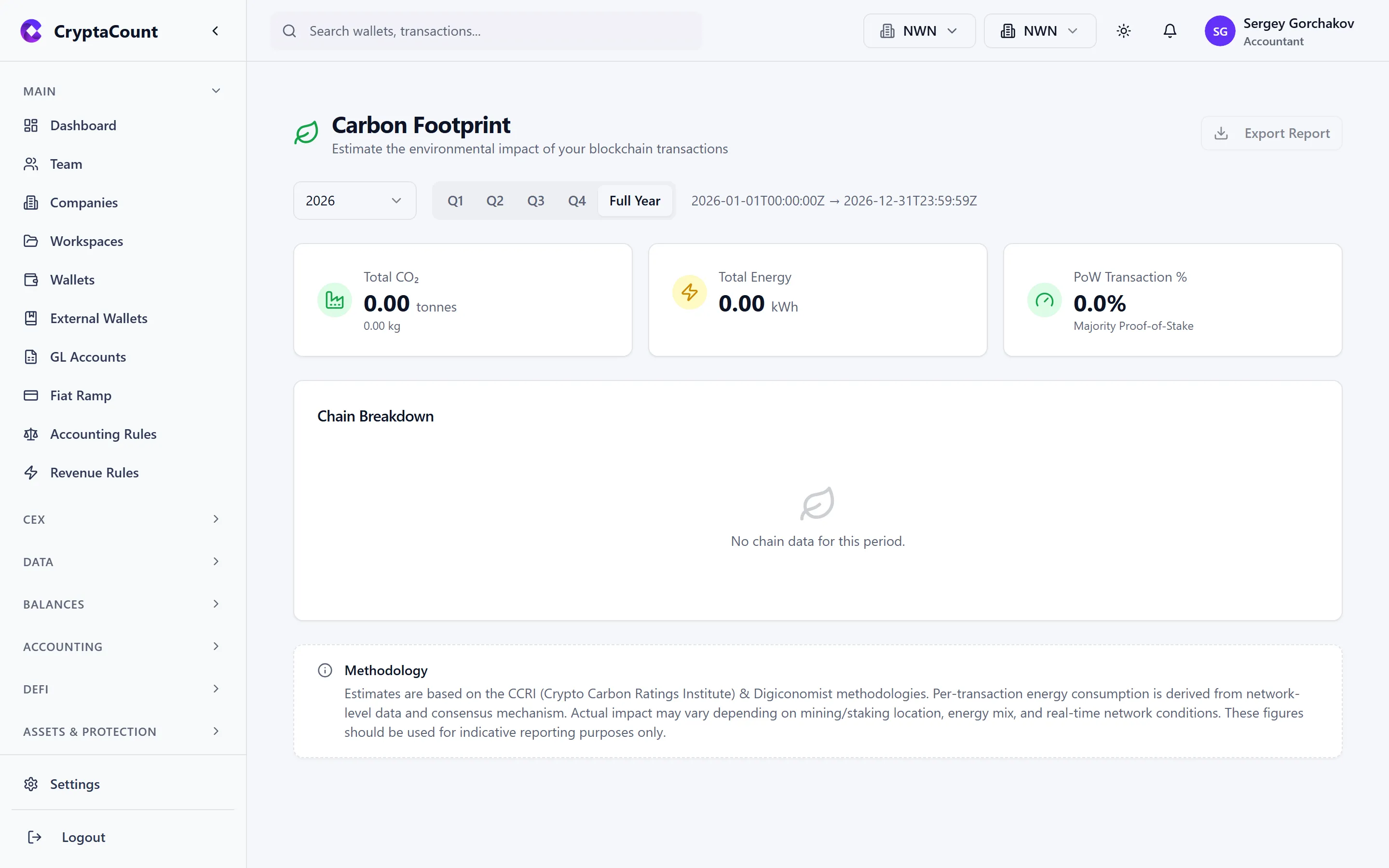
Section titled “Carbon / ESG Estimation”Estimate the carbon footprint of crypto operations under Carbon in the sidebar.
What Carbon/ESG Covers
Section titled “What Carbon/ESG Covers”| Feature | Description |
|---|---|
| Carbon estimation | Estimate CO₂ emissions from blockchain transactions |
| By chain | Emissions broken down by blockchain (PoW vs. PoS) |
| By wallet | Emissions attributed to each wallet’s activity |
| Summary | Aggregate emissions with period-over-period comparison |
How Estimation Works
Section titled “How Estimation Works”CryptaCount estimates carbon footprint based on:
- Chain consensus mechanism — Proof of Work chains (Bitcoin) have significantly higher per-transaction emissions than Proof of Stake chains (Ethereum post-Merge)
- Transaction count — Number of transactions on each chain
- Energy mix data — Regional energy source data for mining (PoW chains)
- Network-level emissions — Published emissions data from blockchain networks
ESG Reporting
Section titled “ESG Reporting”The carbon module generates data suitable for ESG (Environmental, Social, Governance) reporting:
- Scope 3 emissions — Indirect emissions from crypto operations
- Trend analysis — Emissions trend as portfolio shifts between chains
- Reduction strategies — Identify high-emission chains and migration opportunities
- Offset planning — Estimate carbon offset requirements
Example: Acme Digital Holdings reports in their annual ESG disclosure that migrating 80% of operations from Ethereum (pre-Merge) to post-Merge Ethereum reduced estimated crypto-related emissions by 99.4%.
Carbon Summary
Section titled “Carbon Summary”| Metric | Description |
|---|---|
| Total estimated CO₂ | Aggregate emissions in metric tons |
| Per-transaction average | Average emissions per transaction |
| Chain breakdown | Emissions by blockchain with PoW/PoS indicator |
| Year-over-year change | Trend comparison |
Compliance Dashboard
Section titled “Compliance Dashboard”The compliance dashboard provides a unified view:
- Screening status — Recent screening results and pending reviews
- MiCA classification status — Token classification coverage and overrides
- DAC8 reporting status — Reconciliation completeness and upcoming deadlines
- Carbon summary — Current period emissions estimate
- Compliance alerts — Items requiring attention