

Accounting Periods & Period Close
Accounting Periods & Period Close
Section titled “Accounting Periods & Period Close”Accounting periods define the time boundaries over which CryptaCount aggregates transactions, calculates balances, and produces financial reports. The period close workflow ensures data completeness and integrity before finalizing each period.
Creating Accounting Periods
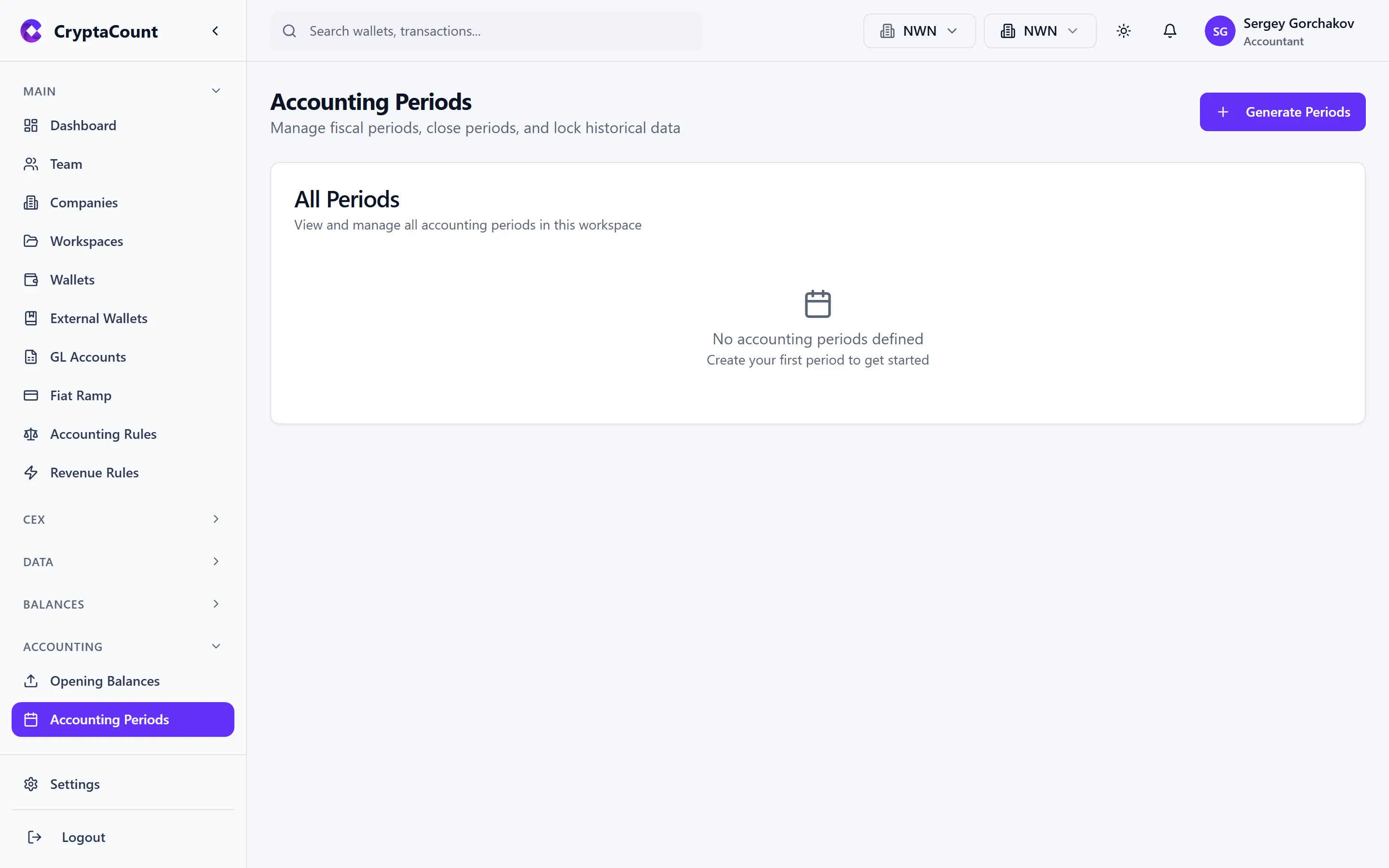
Section titled “Creating Accounting Periods”Navigate to Accounting → Accounting Periods to manage the period calendar for your workspace.
Monthly Periods
Section titled “Monthly Periods”CryptaCount can auto-generate monthly periods for a fiscal year. Each period spans a calendar month (e.g., 2025-01-01 to 2025-01-31). Monthly periods are the most common configuration and align with standard reporting cadences.
To create monthly periods:
- Navigate to Accounting → Accounting Periods
- Select the fiscal year start month
- Click Generate Monthly Periods — CryptaCount creates 12 periods
Custom Periods
Section titled “Custom Periods”For non-standard fiscal calendars (4-4-5, 4-week periods, stub periods), create periods manually:
- Click Create Period
- Set the start and end dates
- Assign a period name (e.g., “Q1 2025” or “Stub — Jan 1–15”)
- Save
Period States
Section titled “Period States”Each period moves through a lifecycle:
| State | Description |
|---|---|
| Open | Transactions can be posted, journals created, balances calculated |
| Closed | No new postings allowed — period has passed close workflow |
| Locked | Permanently sealed — cannot be reopened |
Monthly Close Workflow
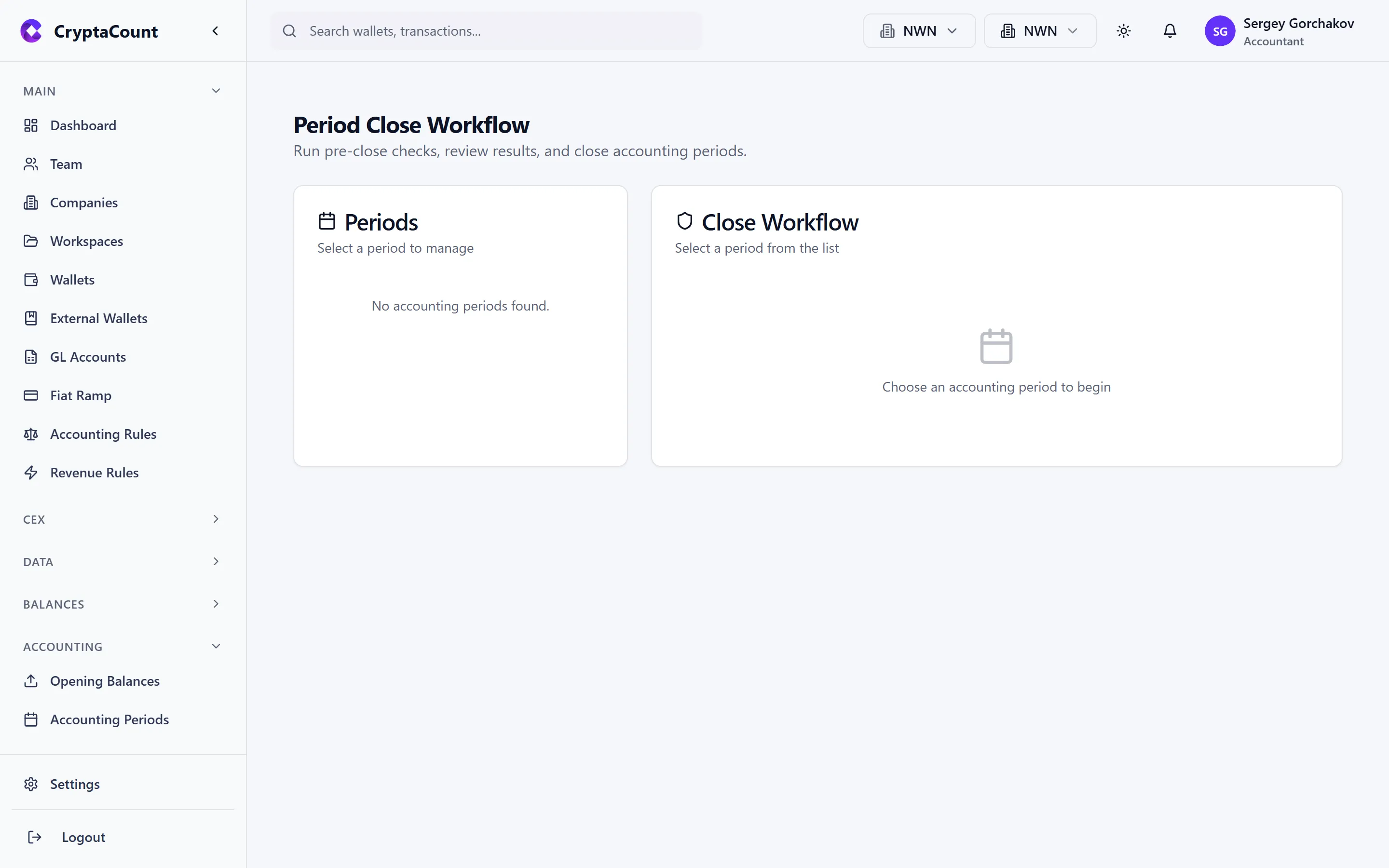
Section titled “Monthly Close Workflow”The period close under Accounting → Period Close follows a structured four-stage process designed to match professional accounting practice.
Stage 1 — Initiate Close
Section titled “Stage 1 — Initiate Close”Select the period to close and click Initiate Close. This triggers the automated check suite and moves the period into “closing” status. No new journal entries can be posted while the close is in progress.
Stage 2 — Run Checks
Section titled “Stage 2 — Run Checks”CryptaCount runs a series of validation checks against the period:
| Check | What It Validates |
|---|---|
| Unmapped addresses | All wallet addresses have GL account mappings |
| Transaction counts | On-chain transaction counts match imported counts |
| Opening vs. closing balances | Opening balances for this period match closing balances of the prior period |
| Internal transfers | Internal transfer pairs are balanced (no orphans) |
| Fee completeness | All transactions with fees have fee amounts recorded |
| Price availability | All assets have price data for the period’s date range |
| CEX matching | CEX import transactions are matched or accounted for |
| Double-entry integrity | Total debits equal total credits across the period |
| Ledger replay | Journal entries can be replayed from source transactions without discrepancy |
| Hash chain integrity | Journal hash chain is unbroken through the period |
Each check returns a pass, warning, or fail status with details.
Stage 3 — Validate & Waive
Section titled “Stage 3 — Validate & Waive”Review the check results:
- All passed — Proceed directly to close
- Warnings present — Review each warning. Warnings do not block close but should be investigated.
- Failures present — Either fix the underlying issue and re-run checks, or waive the failed check with a written justification
Waived checks are recorded in the audit trail with the user who waived, the timestamp, and the justification text. This is visible to auditors reviewing the period.
Example: Acme Digital Holdings might waive a price availability check for an obscure governance token if the position is immaterial, documenting: “GOVXYZ position is €12.40 — immaterial, price manually verified.”
Stage 4 — Complete Close
Section titled “Stage 4 — Complete Close”Click Complete Close to finalize:
- The period status moves to Closed
- A close timestamp and closing user are recorded
- Closing balances are frozen as the opening balances for the next period
- The period appears as “Closed” in the period list
Reopening a Closed Period
Section titled “Reopening a Closed Period”If an error is discovered after close:
- Navigate to the period in Accounting → Accounting Periods
- Click Reopen
- Provide a justification (recorded in audit trail)
- The period returns to Open status
- Make corrections, then run the close workflow again
Year-End Close
Section titled “Year-End Close”The year-end close is a special close operation available on the last period of a fiscal year. In addition to the standard close checks, it:
- Closes all remaining open periods in the fiscal year (runs checks on each)
- Generates closing entries — Revenue and expense accounts are zeroed out to Retained Earnings
- Carries forward balances — Balance sheet accounts (assets, liabilities, equity) carry forward as opening balances for the new fiscal year
- Locks the fiscal year — All periods in the year are locked to prevent accidental reopening
To run year-end close:
- Ensure all periods except the final one are already closed
- Navigate to the final period’s close workflow
- Select Year-End Close instead of standard close
- Review the generated closing entries before confirming
Opening Balances
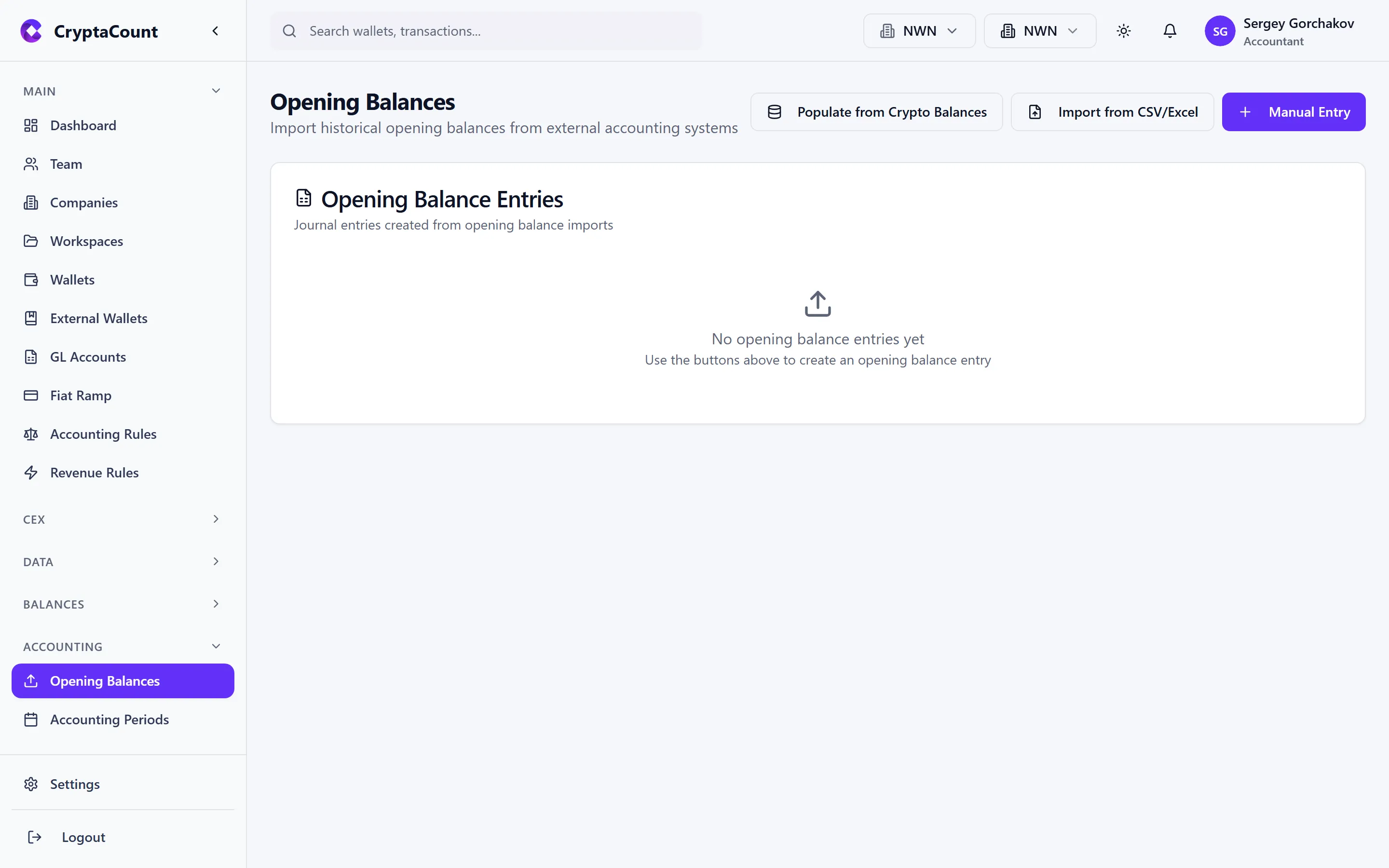
Section titled “Opening Balances”Set the starting position for wallets that held assets before connecting to CryptaCount under Accounting → Opening Balances.
When to Use Opening Balances
Section titled “When to Use Opening Balances”- Migrating from another accounting system to CryptaCount
- Connecting a wallet that has historical activity predating your CryptaCount start date
- Starting a new fiscal year with carried-forward positions
Import Methods
Section titled “Import Methods”File import:
- Navigate to Accounting → Opening Balances
- Click Import
- Upload a CSV with columns: asset, quantity, cost basis, GL account, date
- Preview the import and confirm
Auto-populate:
CryptaCount can suggest opening balance dates based on wallet sync history. Click Suggested Date to use the earliest synced transaction date minus one day. The system calculates positions from on-chain data up to that date.
Manual entry:
Set individual asset balances directly in the UI. Specify the asset, quantity, unit cost basis, and target GL account.
Opening Balance Rules
Section titled “Opening Balance Rules”- Opening balances must be set before running balance calculations for the period
- Each asset’s opening balance is recorded as a journal entry (debit asset account, credit opening balance equity account)
- Once a period is closed, its opening balances cannot be modified without reopening the period
Locking Periods
Section titled “Locking Periods”Locked periods are permanently sealed:
- Cannot be reopened
- No journal entries can be posted or reversed
- Opening balances cannot be modified
- Provides the strongest audit guarantee
To lock a period, it must already be in Closed status. Navigate to the period and click Lock. This action requires Owner or Manager role and is recorded in the audit trail.